
In the construction industry, Canadian employers must prioritize workplace safety. This is achieved by offering the right training courses. I will discuss the essential courses that boost safety and lower accident rates.

The construction safety scene in Canada calls for a proactive stance on training and adherence to legislation. I will underscore the role of these courses in maintaining compliance and fostering a safe workplace.
By concentrating on the most vital construction safety courses, employers can notably enhance their safety record.
The Evolving Landscape of Construction Safety in Canada
The construction industry in Canada is undergoing a significant transformation in its safety approach. This change is driven by new legislation and technological progress. As the industry expands, the need for effective safety measures becomes more critical.
Current Safety Statistics in Canadian Construction
Recent statistics reveal ongoing challenges in construction safety. In Canada, there were 953 work-related fatalities in 2022, with a significant portion in the construction sector. These numbers emphasize the necessity for stringent safety training and adherence to safety legislation.
| Year | Construction Fatalities | Total Work-Related Fatalities |
| 2020 | 173 | 862 |
| 2021 | 185 | 924 |
| 2022 | 194 | 953 |
Legislative Requirements and Compliance in 2025
In 2025, Canadian employers will face updated safety legislation. These include fall protection, confined space entry, and hazardous materials handling. Compliance is not just mandatory; it’s essential for accident prevention. Employers must offer comprehensive training that aligns with these new standards.

Fall Protection Training: Preventing the Leading Cause of Construction Fatalities
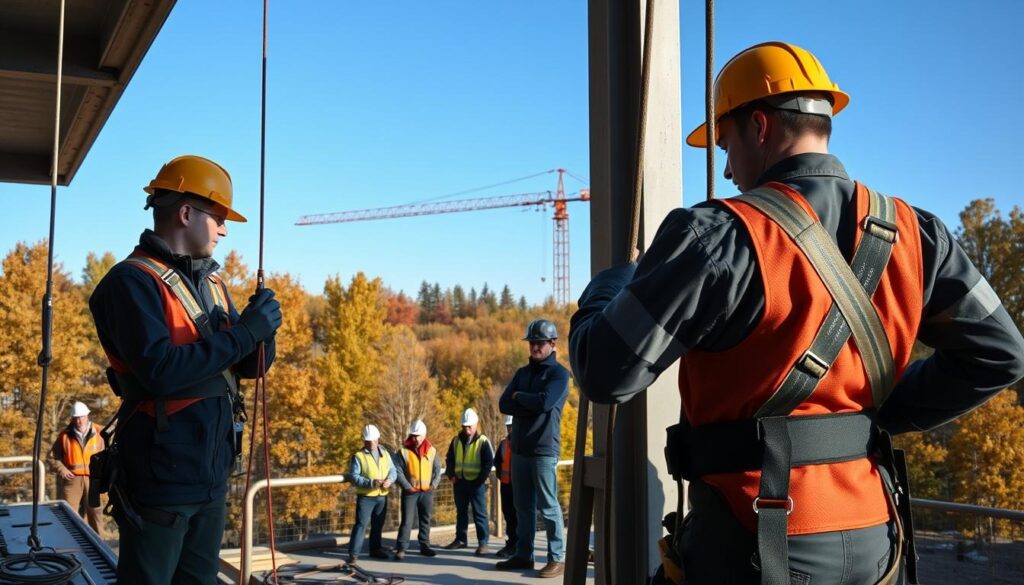
In Canada, the construction sector faces significant risks, with falls being a major contributor to workplace fatalities. This highlights the need for rigorous fall protection training. Fall protection training is crucial for construction safety. It equips workers with the knowledge and skills to prevent falls from heights. This reduces the risk of serious injuries and fatalities.
Core Components of Comprehensive Fall Protection Programs
A comprehensive fall protection program includes several core components. Proper equipment is essential, encompassing a range of fall protection gear such as harnesses, lanyards, and anchors. Training is another vital element, ensuring that workers understand how to use this equipment correctly and safely. Additionally, supervision plays a critical role in enforcing safety protocols and ensuring compliance with legislative requirements.
Canadian Standards Association (CSA) Certification Requirements
The Canadian Standards Association (CSA) sets stringent standards for fall protection equipment and training. Employers must ensure their fall protection programs meet these standards. This includes using CSA-approved equipment and training programs that adhere to CSA guidelines.
Implementation Strategies for Employers
To effectively implement fall protection training, employers should adopt a multi-faceted approach. This includes integrating fall protection training into their overall safety protocols. Employers should conduct regular training sessions and ensure all workers are certified in fall protection procedures. By prioritizing fall protection training, employers can significantly reduce the risk of falls and create a safer working environment.
Confined Space Entry and Rescue Certification
In Canada, employers must prioritize training in confined space entry and rescue. This is a critical aspect of construction safety. Confined spaces, like tanks and pipelines, are dangerous due to their design and potential hazards. These areas can pose risks such as toxic gases and limited space.
Hazard Identification and Assessment
Identifying hazards in confined spaces is the first step to ensuring safety. It involves checking for toxic gases and ensuring there’s enough oxygen. Employers must also consider the physical dangers of these spaces, like being trapped.
- Conduct thorough risk assessments before entry.
- Implement control measures to mitigate identified hazards.
- Ensure workers are trained in hazard recognition.
Practical Skills and Emergency Response
Practical skills are crucial for working in confined spaces. Workers need training on using protective gear and rescue tools. They must also know how to respond in emergencies, including calling for help and performing rescues.
Key components of practical training include:
- Hands-on training with rescue equipment.
- Simulation of emergency scenarios.
- Practice in confined space entry procedures.
Leading Canadian Training Providers
Canada has several top training providers for confined space entry and rescue. These programs are tailored for the Canadian construction industry. They meet all necessary legislation and standards.
Investing in confined space training is vital for Canadian employers. It ensures workers can handle these dangerous situations safely. This reduces accident risks and improves construction site safety overall.
Boost Construction Site Safety: Top 5 Courses for Canadian Employers
In Canada, ensuring construction site safety is paramount. Employers must invest in the right training programs. Beyond fall protection and confined space entry, other critical courses are essential for site safety.
Scaffolding Safety and Competent Person Training is a must. It teaches workers how to safely erect, use, and dismantle scaffolding. This reduces accident risks significantly.
Scaffolding Safety and Competent Person Training
This program emphasizes the critical role of scaffolding safety. It covers hazard identification and safety measures. It also trains supervisors to oversee scaffolding operations effectively.
Excavation and Trenching Safety Certification
Excavation and trenching are high-risk activities. They require specialized training. The certification program addresses excavation hazards, protective systems, and emergency response.
Integration with Provincial Health and Safety Requirements
Ensuring safety training meets provincial health and safety legislation is crucial. This integration helps employers avoid non-compliance issues. It ensures a safe working environment.
| Course | Description | Provincial Compliance |
| Scaffolding Safety | Training on scaffolding erection, use, and dismantling | Yes |
| Excavation and Trenching Safety | Certification on excavation hazards and protective systems | Yes |
Hazardous Materials Handling and WHMIS2015
Training in hazardous materials handling is crucial for a safe construction site. Workers must know the dangers of hazardous materials and how to manage them safely.
Also Read: Understand Flagging vs Rigging
Chemical Safety and GHS Compliance
The Globally Harmonized System (GHS) offers a unified method for classifying and labeling chemical hazards. Employers must ensure their workers are trained in GHS compliance to handle chemicals safely. This includes understanding safety data sheets (SDSs) and label requirements.
Asbestos, Silica, and Other Construction-Specific Hazards
Construction workers face risks from hazardous materials like asbestos and silica, which can lead to serious health problems. Training programs should cover the risks associated with these materials and provide guidance on safe handling practices. This includes understanding the proper use of personal protective equipment (PPE) and procedures for minimizing exposure.
Record-Keeping and Documentation Requirements
Accurate record-keeping is essential for compliance with hazardous materials handling legislation. Employers must keep detailed records of worker training, exposure monitoring, and SDSs. The following table outlines key documentation requirements:
| Documentation Type | Retention Period | Responsible Party |
| Worker Training Records | 3 years | Employer |
| Safety Data Sheets (SDSs) | 30 years | Employer |
| Exposure Monitoring Records | 30 years | Employer |
By offering comprehensive training on hazardous materials handling and keeping accurate records, employers can reduce risks. This ensures compliance with WHMIS2015 legislation.
Conclusion:
In conclusion, creating a robust safety culture through education is vital for Canadian construction employers. Offering the best construction safety courses is key. This approach boosts workplace safety, cuts down on accidents, and meets Canada’s legislative standards.
To enhance construction site safety, prioritizing safety training and education is crucial. Workers need to know how to spot and manage hazards, handle emergencies, and follow the law. This knowledge is essential for their safety and the safety of their colleagues.
Investing in safety education makes workplaces safer. It fosters a positive safety culture in the construction sector. This leads to better productivity, lower costs from accidents, and a stronger reputation for employers.